OSHA Shoe Compliance Checker
Select Your Job Type
Select Additional Hazards
If you work in construction, manufacturing, warehousing, or any job where heavy objects, sharp tools, or slippery floors are part of the day, your shoes aren’t just about comfort-they’re your first line of defense. That’s where OSHA compliant shoes come in. But what does that actually mean? And how do you know if the boots you’re buying are truly safe, or just labeled as such?
What OSHA Actually Requires
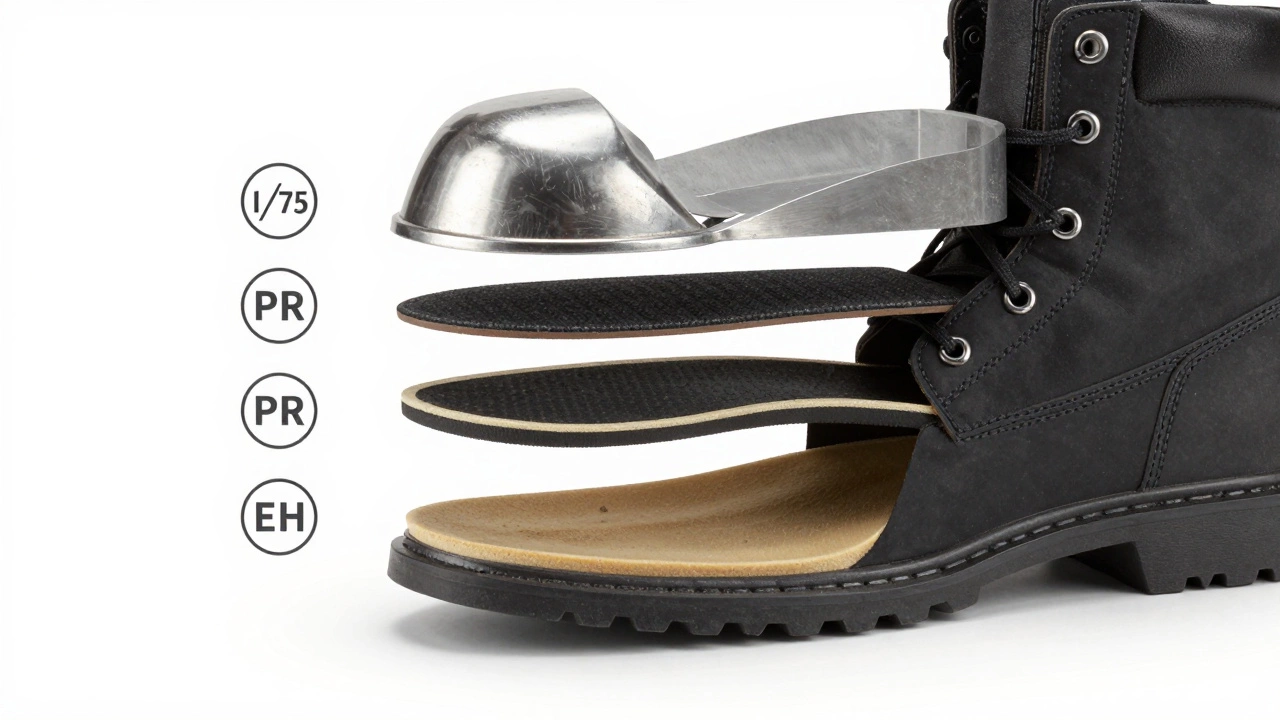
OSHA, or the Occupational Safety and Health Administration, doesn’t write the exact design rules for work shoes. Instead, it points to a standard created by ASTM International: ASTM F2413. This is the real rulebook. OSHA says employers must ensure workers wear footwear that meets this standard. So when someone says "OSHA compliant," they’re really saying "ASTM F2413 compliant." The standard covers three main things: impact resistance, compression resistance, and puncture resistance. These aren’t vague ideas-they’re tested with real numbers. For example, a shoe with an I/75 rating means it can handle a 75-pound weight dropped from 18 inches without crushing your toes. That’s the equivalent of a 30-pound sledgehammer falling from waist height.What Makes a Shoe OSHA Compliant?
Not every tough-looking boot is safe. Here’s what you need to look for:- Steel toe or composite toe-Steel offers the most protection but can be heavy. Composite toes (made of plastic, fiberglass, or carbon fiber) are lighter and won’t set off metal detectors. Both meet the same impact standards.
- Metatarsal protection-Some jobs involve falling objects that hit above the toes. Shoes with met guard shields protect the top of the foot. These are common in logging or steel fabrication.
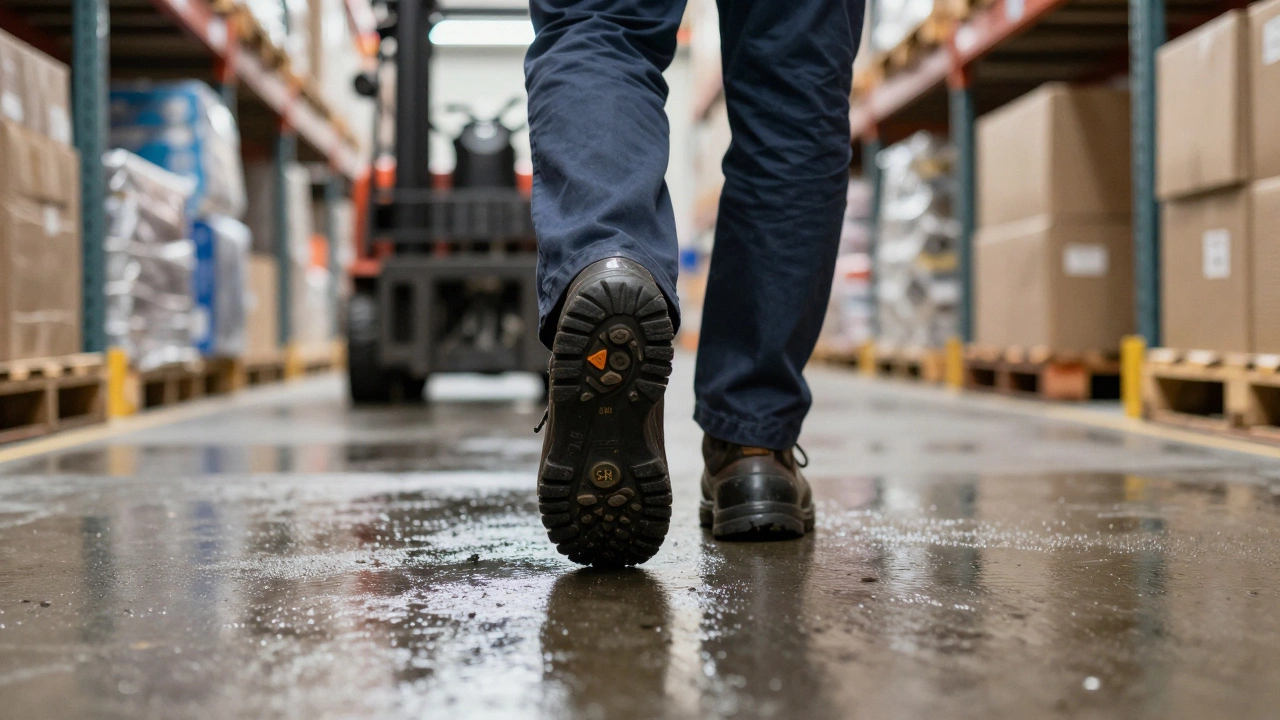
- Slip-resistant soles-OSHA doesn’t require a specific sole pattern, but OSHA does require employers to reduce slip hazards. Shoes marked with ASTM F2913 are tested for slip resistance on oily, wet, and ceramic tile surfaces. Look for labels like "Slip Resistant" or "SR" on the sole.
- Puncture-resistant midsole-If you’re working on construction sites with nails or in recycling plants with sharp debris, you need a puncture-resistant plate between the insole and outsole. This is often made of steel or Kevlar.
- Electrical hazard protection-Some boots are rated to reduce the risk of electric shock from live circuits. These are marked as EH (Electrical Hazard) and are tested to withstand up to 18,000 volts under dry conditions.
These features aren’t optional. In 2023, OSHA reported over 12,000 foot injuries in U.S. workplaces-nearly half of them involved crushed toes or punctures. Most of these could’ve been prevented with proper footwear.
How to Spot a Real OSHA Compliant Shoe
You’ll often see boots labeled "OSHA approved" or "meets OSHA standards." That’s misleading. No single shoe is "approved" by OSHA. Instead, the manufacturer tests the shoe to ASTM F2413 and labels it correctly.Look for a label inside the shoe or on the box that says:
- ASTM F2413-21 (the current version as of 2025)
- Impact rating: I/75 or I/50
- Compression rating: C/75 or C/50
- Puncture resistance: PR
- Slip resistance: SR (if tested to ASTM F2913)
- Electrical Hazard: EH
Some brands put these codes on the tongue or heel. If you can’t find them, ask for the product’s test certification. Reputable brands like Timberland PRO, Red Wing, Wolverine, and Carhartt include this info openly.
Common Myths About Safety Shoes
There’s a lot of confusion out there. Let’s clear up the biggest myths:- Myth: All black work boots are OSHA compliant. Truth: Color doesn’t matter. A shiny black boot with no markings is just a boot.
- Myth: Composite toes are weaker than steel. Truth: Composite toes meet the same impact and compression standards. They’re just lighter and better for cold environments.
- Myth: You don’t need them if you’re only on-site for a few hours. Truth: One falling tool is all it takes. Injuries happen fast, and OSHA rules apply to every minute you’re in a hazard zone.
- Myth: OSHA will fine you for not wearing them. Truth: OSHA fines the employer, not the worker. But if your employer requires them and you refuse, you can be disciplined or fired.
Choosing the Right Pair for Your Job
Not every job needs the same shoe. Here’s how to match your footwear to your risks:| Job Type | Key Risks | Required Features |
|---|---|---|
| Construction | Falling tools, nails, uneven ground | Steel or composite toe, puncture-resistant sole, slip-resistant outsole |
| Warehouse | Pallets, forklifts, wet floors | Composite toe (for lightness), slip-resistant sole, cushioned midsole |
| Manufacturing | Heavy machinery, metal shavings | Steel toe, metatarsal guard, puncture-resistant sole |
| Electrical Work | Live wires, sparks | Electrical Hazard (EH) rating, non-conductive sole |
| Food Processing | Wet floors, grease, chemicals | Slip-resistant, chemical-resistant sole, easy-to-clean material |
| Logging / Forestry | Sharp branches, falling logs | Steel toe, metatarsal guard, puncture-resistant sole, ankle support |
Don’t forget comfort. If your shoes hurt after two hours, you’ll stop wearing them-or wear them wrong. Look for cushioning, arch support, and breathable materials. Some brands now use memory foam insoles and moisture-wicking linings without sacrificing protection.
When to Replace Your Safety Shoes
Even the best shoes wear out. Replace them if:- The toe cap is visibly dented or cracked
- The sole is worn down to the midsole or shows deep cracks
- The puncture-resistant layer is exposed
- The slip-resistant tread is smooth in high-wear areas
- You feel more foot fatigue than usual
Most safety shoes last 6 to 12 months with daily use. In harsh environments, they may need replacing every 3 to 4 months. Keep a log. Many companies require workers to sign off on shoe inspections every 90 days.
What Happens If You Don’t Wear Them?
The consequences go beyond personal injury. Employers who don’t provide or enforce proper footwear can face OSHA fines up to $16,550 per violation. Repeat or willful violations can hit $165,500. But the real cost? Lost productivity, workers’ comp claims, and sometimes, a life changed forever.In 2024, the U.S. Bureau of Labor Statistics found that foot injuries led to an average of 11 days off work per case. Multiply that by hundreds of workers in a single plant, and you’re looking at thousands of lost workdays-and millions in costs.
Final Checklist Before You Buy
Before you hand over your money, ask yourself:- Does the label say ASTM F2413-21? (Not just "safety boot" or "industrial".)
- Are the impact and compression ratings clearly listed?
- Do I need puncture resistance? Slip resistance? Electrical hazard protection?
- Have I tried them on with the socks I wear to work?
- Does the store provide a copy of the test certification?
If you can answer yes to all five, you’ve got a real pair of OSHA compliant shoes. If not, keep looking.
Are OSHA compliant shoes the same as safety boots?
Yes, but "safety boots" is a general term. OSHA compliant shoes are a specific subset that meet ASTM F2413 standards. Not all safety boots are compliant-only those tested and labeled with the correct ASTM ratings.
Can I wear OSHA compliant shoes outside of work?
Absolutely. Many modern OSHA compliant shoes are designed to look like regular work boots or even casual footwear. Brands like Timberland PRO and Keen offer styles that are safe on the job and stylish off it. Just make sure the ASTM label is still visible if you need to prove compliance.
Do I need to buy new shoes every year?
Not necessarily. High-quality safety shoes can last 12 to 18 months with moderate use. But if you work in a high-wear environment-like a steel mill or construction site-you may need replacements every 6 months. Check for sole wear, toe damage, or loss of cushioning. Don’t wait until they break.
Can I use steel toe boots in cold weather?
Steel toes can feel colder than composite toes because metal conducts temperature. If you work in freezing conditions, choose composite toe boots with insulated linings. Many brands now offer waterproof, insulated models with ASTM-rated protection that perform well below zero.
Is it legal for my employer to make me pay for safety shoes?
In the U.S., under OSHA regulations, employers must provide required personal protective equipment at no cost to employees if the equipment is used solely for work purposes. This includes safety shoes if they’re required for your job. Some employers offer reimbursement or allow payroll deductions-but you can’t be forced to pay for mandatory safety gear.